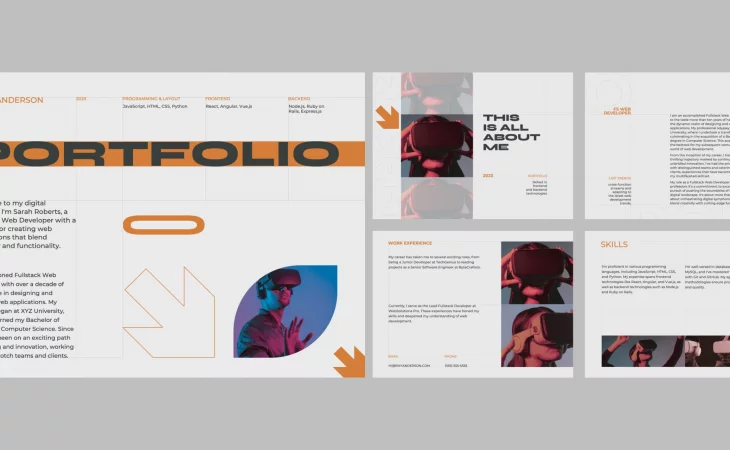
There's a persistent misconception in the design community that a strong portfolio is primarily a collection of attractive visuals — a gallery of polished end-states that demonstrates technical skill and aesthetic sensibility. This framing isn't entirely wrong, but it's incomplete in ways that often matter. The most effective design portfolios communicate something more specific and more useful: they show how a designer thinks, how they approach problems, and how they function within the broader ecosystem of a project.
That shift in framing — from gallery to demonstration — changes almost every decision involved in building a portfolio. It affects what you include, how you structure each piece, what you choose to explain, and ultimately how your work lands with the people evaluating it.
What a Portfolio Is Actually For
A design portfolio serves a specific communicative function: it's a curated argument for why you would be valuable on a particular kind of project or within a particular kind of team. Understanding this function helps clarify what belongs in it and what doesn't.
For most design roles, portfolio reviewers are trying to answer three questions. First: does this designer produce work at a quality level appropriate for what we do? Second: does their approach to problems align with the kinds of problems we face? Third: can they communicate clearly about their own work — a quality closely correlated with the ability to communicate clearly in a team setting?
Visual quality addresses the first question. Case study depth addresses the second. Writing quality — the clarity and precision of your descriptions, annotations, and process documentation — addresses the third. A portfolio that focuses only on visual quality is effectively leaving two of the three questions unanswered.
Curation Over Volume
The instinct to include more work in a portfolio is understandable but usually counterproductive. A reviewer spending twenty minutes with your portfolio — a generous estimate for most initial screenings — doesn't benefit from seeing twelve projects. They benefit from seeing four or five projects presented with enough depth and clarity that the work, your thinking, and your process become genuinely legible.
The practical recommendation that has held up consistently across hiring conversations and industry feedback is: include between three and six projects, selected not primarily for their visual impressiveness but for the quality of the story they allow you to tell.
Some useful questions for selection:
- Does this project show a problem worth solving? Interesting constraints make for interesting portfolios.
- Can I explain what I actually did, as distinct from what the team did collectively?
- Is there a discernible journey from brief or problem to outcome — not just a final result?
- Does this project represent the kind of work I want to do more of?
That last point matters more than designers sometimes acknowledge. A portfolio that includes a project only because it looks good but doesn't reflect the direction you want to move in is doing quiet damage — it signals interest in work you may not want, and attracts opportunities that may not serve your actual goals.
"The most effective design portfolios communicate how a designer thinks, how they approach problems, and how they function within the broader ecosystem of a project."
The Case Study Format
The case study has become the standard format for presenting portfolio work because it allows designers to communicate context, process, and outcome in a structured way. Done well, a case study is significantly more persuasive than a set of final screens — it shows that you understood what you were doing and why, rather than simply executing tasks.
A functional case study typically includes:
The brief and context
What were you asked to do, and why did it matter? Who was the client or internal stakeholder? What constraints existed from the outset — timeline, technical limitations, brand requirements, budget? Framing the problem clearly demonstrates that you engaged with it thoughtfully rather than jumping straight to execution.
Your role
Be specific about what you contributed. "I designed the mobile experience" is clearer and more honest than "I designed the app," if the latter was a team effort. Portfolio reviewers are sophisticated enough to appreciate clarity about contribution, and vagueness here tends to create doubt rather than prevent it.
The process
This doesn't have to be exhaustive or visually elaborate. A clear description of how you moved from problem to solution — with a few representative artefacts (early sketches, wireframes, user testing notes, iteration comparisons) — communicates more about your working method than any number of final screens. It's also where the work often gets interesting: early ideas that were discarded, pivots that happened mid-project, constraints that shaped unexpected decisions.
The outcome
What was actually delivered? If there are measurable results — engagement changes, user satisfaction improvements, workflow efficiencies — include them. If there aren't, describe the outcome in qualitative terms: what problem does the delivered work solve, and for whom? Avoid inflating results or projecting outcomes that weren't actually measured.
Why Context and Process Matter
It's worth pausing on why process documentation matters so much, because it can feel counterintuitive to designers who've been told their portfolio is primarily a visual showcase.
Design work doesn't happen in isolation — it happens within organisations, teams, budgets, and timelines. The ability to navigate constraints, collaborate with non-designers, incorporate feedback, and arrive at solutions that work within real-world conditions is a core professional skill. Process documentation is how you demonstrate that you have it.
A designer who shows only polished final work is presenting one dimension of their professional capability. A designer who shows how they moved from an ambiguous brief to a delivered solution, what decisions they made along the way, and what they learned from the experience — that designer is presenting a much more complete and compelling professional picture.
This is particularly true for complex, multi-stakeholder projects. A case study from a large product redesign or a complicated wayfinding system that shows the process clearly will often be more persuasive to a senior reviewer than a series of beautiful final screens from simpler projects.
What to Leave Out
Curation applies to what you exclude as much as what you include. A few categories of work consistently add less value than designers hope:
Student and academic work tends to belong in the portfolio only if it genuinely demonstrates something that your professional work doesn't — a relevant discipline, an unusual approach, or strong conceptual thinking that your commercial work hasn't allowed you to express. If your professional work is stronger, the academic work should probably go.
Concept projects and personal explorations can be valuable when they're genuinely well-executed and clearly labelled. The important word is labelled. A reviewer who assumes they're seeing professional client work and then discovers it was a self-initiated concept project may feel slightly misled, even if the work is good. Clarity about the nature and context of each piece is worth more than the impression of a more impressive project history.
Work you can't speak to confidently is almost always worth omitting. If you were a small contributor to a large project, or if your role was primarily execution rather than conception, the case study may not give you enough to say. Including work that you struggle to explain under questioning creates a bad impression — better to have fewer, stronger stories.
"A portfolio that includes a project only because it looks impressive but doesn't reflect where you want to go is doing quiet damage — it signals interest in work you may not want."
Choosing Your Presentation Medium
The question of where and how to host your portfolio has no universal answer, and the choice tends to matter less than designers sometimes fear. What matters is that the medium you choose doesn't introduce friction or distraction — that the work can be found, loaded, and read without technical issues or navigational confusion.
Purpose-built portfolio platforms offer the advantage of established conventions: reviewers know where to look for things, and the platforms handle technical concerns like responsive layout and image optimisation. Custom-built portfolio sites offer more control and can themselves serve as demonstrations of technical or design capability — valuable primarily for web and digital product designers for whom the site is itself a work sample.
PDF portfolios have largely fallen out of favour for digital roles but remain common in some print, publishing, and motion contexts. If you're submitting a PDF, compress it aggressively — a portfolio that takes thirty seconds to download is already making a bad impression before it's been opened.
Whatever medium you choose, test it rigorously across devices. A portfolio that breaks on mobile is a significant credibility issue for a digital designer in particular, and a small embarrassment even for designers in other disciplines.
Early Career Portfolios
Designers early in their careers face a specific version of the portfolio problem: they may have limited professional work and substantial academic or personal work, and they may be uncertain how to present either category effectively.
A few things are worth knowing. First, early career reviewers generally expect this, and a portfolio of strong student and personal work is a perfectly acceptable basis for entry-level evaluation. What matters is the quality of the work and the quality of the thinking demonstrated, not the professional pedigree of the projects.
Second, personal projects can be genuinely compelling when they're executed with the same seriousness as professional work. A self-initiated redesign of a public service, a speculative product concept for a well-framed problem, or a research-led exploration of a design question — when these are done carefully and presented with honest context, they can demonstrate capability and initiative more effectively than weak professional work from early-career roles.
Third, clarity about your learning is valuable. If a student project taught you something specific about design decision-making, user research, or technical constraints, saying so in your case study documentation is not a sign of inexperience — it's a sign of self-awareness, which is consistently valued in design hiring.
Keeping Your Portfolio Current
A portfolio that doesn't reflect your current capabilities and interests is doing you a quiet disservice. This is worth thinking about proactively rather than only when you're actively looking for work.
The practical habit that tends to work best is documenting projects as they're completed, while the details, decisions, and reasoning are still fresh. Writing a case study six months after a project is finished is considerably harder than writing it while the project is recent — you'll have forgotten nuances, and the documentation will tend to flatten into a bare description of outputs rather than a genuine account of the process.
A portfolio review every six months — even briefly, to assess whether the work still represents your current level and direction — tends to keep things in reasonable shape without requiring bursts of intensive effort.
Conclusion
Building a portfolio that genuinely serves your professional goals is a design problem in its own right — one that requires the same intentionality, clarity of purpose, and attention to the audience's experience as any other design challenge. The designers who approach it that way, thinking carefully about what each piece communicates and to whom, tend to produce portfolios that are more useful professionally than those assembled primarily for visual impressiveness.
The honest truth about design portfolios is that there's no formula. Different roles, different disciplines, and different career stages all require different approaches. What holds across most contexts is the underlying principle: show real work, explain it honestly, document your thinking, and curate with the reviewer's questions in mind. A portfolio built on those foundations is unlikely to mislead either the viewer or yourself about the work you do and the direction you want to take.
About TIMETORIOT Editorial
This article was written by the TIMETORIOT editorial team. Our articles are produced with the goal of providing genuine, practical value to creative professionals — without exaggerated claims, SEO filler, or artificial urgency.