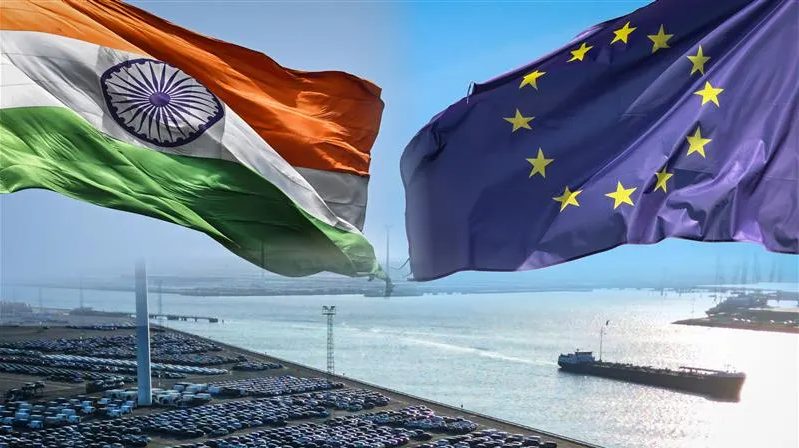
As international trade tensions continue to rise, the European Union and India are preparing a new economic partnership. The agreement could transform business opportunities, manufacturing and global supply chains for years to come.
BRUSSELS / NEW DELHI — OCTOBER 27, 2026
A major shift is taking place in the global economy.
For decades, international trade has been shaped by relationships between the United States, Europe and China. But changing economic priorities and growing uncertainty are encouraging governments to seek new partnerships.
Now, the European Union and India are taking an important step toward a different future.
Following the conclusion of free trade negotiations in January 2026, both sides are preparing to establish one of the world's most significant commercial partnerships.
The agreement could create new opportunities for businesses operating across a combined market of approximately two billion people.
But the most important question goes beyond tariffs and trade statistics.
Could the growing partnership between Europe and India change the balance of economic power around the world?
A Trade Agreement Years in the Making
The relationship between the European Union and India has developed over decades.
Negotiations for a comprehensive free trade agreement originally began in 2007.
However, disagreements over tariffs, market access and regulatory requirements led to the suspension of negotiations in 2013.
Talks resumed in 2022 as both sides recognized the importance of strengthening their economic relationship.
On January 27, 2026, European and Indian leaders announced the successful conclusion of negotiations.
The agreement was presented as a landmark development in international commerce.
It covers trade in goods and services, customs procedures, digital trade and other areas of economic cooperation.
However, concluding negotiations does not mean the agreement has already entered into force.
Formal approval and ratification procedures must still be completed.
Why Europe Is Turning Its Attention Toward India
India is one of the world's largest and fastest-developing major economies.
Its enormous consumer market, expanding manufacturing sector and growing technology industry make it an attractive destination for international companies.
European businesses already export machinery, chemicals, pharmaceuticals and other products to India.
Yet high import tariffs have historically made certain European goods more expensive in the Indian market.
The new agreement aims to reduce these barriers.
According to the European Commission, tariffs will be eliminated or reduced on approximately 96.6% of EU goods exports by value.
The Commission estimates that the reductions could save European exporters around €4 billion annually once the relevant provisions are implemented.
These are projected benefits rather than savings already realized.
A Major Opportunity for European Car Manufacturers
One of the agreement's most closely watched features concerns the automotive industry.
India has traditionally imposed high import duties on foreign vehicles.
Under the negotiated terms, tariffs on certain European cars could be reduced from levels reaching 110% to approximately 10%.
The reductions will be subject to quotas and implementation schedules.
For European automakers, this could improve access to a large and growing consumer market.
Companies may find it easier to introduce additional models or expand their presence in India.
However, domestic Indian manufacturers will continue to compete for customers, and not all vehicles will receive identical treatment.
The agreement creates opportunities but does not guarantee higher sales.
Indian Exports Could Find a Larger European Market
The partnership is also expected to benefit Indian manufacturers.
Textiles, clothing, footwear, chemicals and certain engineering products are among the sectors expected to gain improved market access.
India has a substantial manufacturing base in labor-intensive industries.
Reduced tariffs could make eligible Indian goods more competitive in European markets.
For European businesses, this may create additional sourcing options.
Consumers could eventually benefit from greater product variety and more competitive prices in certain categories.
However, the final effect on retail prices will depend on transportation costs, competition, exchange rates and other market conditions.
Could This Change the Relationship With China?
The growing EU–India partnership has attracted attention partly because global supply chains are changing.
Many international companies are seeking to reduce excessive dependence on individual manufacturing locations.
India has emerged as a potential destination for expanded production and investment.
A free trade agreement with Europe could make some commercial arrangements more attractive.
However, this does not mean European companies will abandon China.
China remains a major manufacturing center and trading partner with established infrastructure and extensive industrial capabilities.
Instead, businesses may increasingly pursue diversified supply chains involving several countries.
The EU–India agreement could support this gradual process.
What Does the Agreement Mean for the United States?
The United States remains an important trading partner for both Europe and India.
However, international tariff disputes have highlighted the risks associated with relying heavily on a limited number of commercial relationships.
By strengthening cooperation, Europe and India may gain additional options for trade and investment.
This could give businesses greater flexibility when responding to changes in international economic conditions.
The agreement should not necessarily be interpreted as an effort to weaken relations with Washington.
Rather, it reflects a broader trend toward diversifying global economic partnerships.
For the United States, the development illustrates how other major economies are building new commercial relationships while international trade policy continues to evolve.
The Technology Sector Could Be a Major Beneficiary
The partnership extends beyond traditional manufacturing.
Europe and India have complementary strengths in technology.
European companies possess expertise in industrial engineering, advanced manufacturing and specialized equipment.
India has a large software industry, an established IT services sector and a growing technology ecosystem.
Closer cooperation could create opportunities involving artificial intelligence, digital infrastructure, cybersecurity and advanced industrial systems.
The EU–India Trade and Technology Council provides an additional forum for cooperation on these subjects.
Nevertheless, specific technology investments will depend on commercial decisions and regulatory requirements.
The free trade agreement does not automatically create or finance individual AI projects.
What About Jobs and Economic Growth?
Trade agreements can influence employment in several ways.
Businesses gaining access to new markets may expand production and hire additional workers.
Importers may benefit from lower costs or broader supplier networks.
International investment can support new facilities and services.
However, greater trade competition can also create challenges for some domestic producers.
Businesses that previously benefited from high import duties may need to adapt.
The overall employment impact will depend on how economic activity changes across different sectors.
For both Europe and India, the goal is to turn improved market access into sustainable economic growth.
The Hidden Challenge: Tariffs Are Only Part of the Story
Reducing customs duties is an important step, but international trade involves many other requirements.
Products must comply with safety standards, labeling rules and technical regulations.
Businesses also need to understand customs documentation and rules of origin.
These rules determine whether a product qualifies for preferential treatment under a trade agreement.
In some cases, tariff reductions will be introduced gradually over several years.
This means that companies cannot assume every import duty will disappear immediately.
Careful planning will be necessary to take full advantage of the agreement.
A Critical Update From October 2026
On October 22, Indian Commerce and Industry Minister Piyush Goyal indicated that the agreement could become operational in early 2027.
The two sides are working toward completing the necessary arrangements, with signing anticipated before the end of 2026.
The European Commission had already submitted its proposals for signature and conclusion to the Council of the EU on September 11.
Additional steps include authorization by the Council, signing, consent from the European Parliament and completion of India's domestic procedures.
The expected timeline remains subject to these requirements.
Until the agreement enters into force, businesses must continue following currently applicable tariffs and trade rules.
Could 2027 Become a Turning Point?
If the agreement becomes operational in 2027, businesses could begin benefiting from its provisions according to the applicable implementation schedules.
European manufacturers may gain improved access to India's market.
Indian exporters may become more competitive in selected European sectors.
Technology companies may explore new partnerships.
Investors could also examine opportunities connected to expanding international trade.
However, economic benefits will depend on actual business activity rather than announcements alone.
Companies must still evaluate market demand, costs and commercial risks.
A New Era of Global Economic Partnerships
The EU–India agreement represents a broader change in how major economies approach international commerce.
Governments are seeking reliable partners, resilient supply chains and opportunities for long-term economic cooperation.
Instead of depending entirely on established relationships, countries are developing more diversified trade networks.
India's growing economic influence and Europe's large consumer market create strong incentives for cooperation.
At the same time, the agreement demonstrates that negotiations to reduce trade barriers remain possible despite international tensions.
The future of global commerce may increasingly involve several major economic centers rather than a limited number of dominant relationships.
Conclusion: Europe and India Are Preparing for a Different Economic Future
The proposed EU–India free trade agreement is one of the most significant international trade developments of 2026.
Its provisions could reduce tariffs, create new export opportunities and strengthen cooperation across manufacturing, technology and services.
The potential benefits extend to businesses, consumers and investors in both markets.
Yet the agreement must still complete the required legal procedures.
Its long-term success will depend on implementation, business investment and the ability of companies to adapt.
The global economic order is changing, and the growing partnership between Europe and India could become a defining example of how international trade evolves in the years ahead.
For now, the world is watching as Brussels and New Delhi prepare to turn a major diplomatic achievement into a practical economic relationship.